

_ Department (Nano and Micro Electromechanical MEMS )
Structure description ( metallization) in ( nano- electrical and mechanical) systems - two important parameters
Researcher and Author: Dr. ( Afshin Rashid)
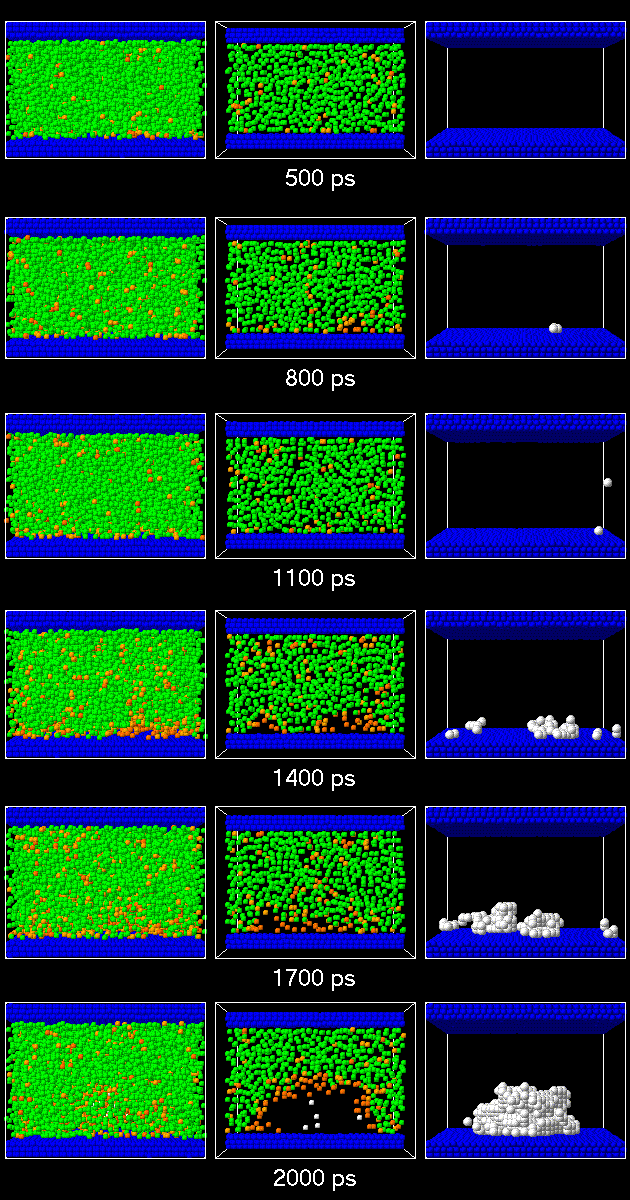

The synthesis and characterization of metal nanoparticles is a major field in the fabrication of (nano- and micro- electromechanical MEMS) systems. The use of nanoparticles in nanoelectronics applications is particularly important, as when the size of metal particles reaches the nanometer scale, they often exhibit optical, magnetic, electrical and chemical (catalytic) properties. The use of fine metal particles in decomposition is of particular interest due to their irregular surface - which is constantly remodeled to adapt to the adsorbent - and their size-dependent electronic properties, which can be tuned to optimize catalytic activity and selectivity in the fabrication of (nano- and micro -electromechanical MEMS) systems . Our group is able to synthesize a wide range of metal nanoparticles and metal oxide nanoparticles for applications in catalysts and in (nano- and micro -electromechanical MEMS) systems . A major challenge in the preparation of colloidal suspensions of nanoparticles is stability, as they tend to aggregate to minimize surface tension. For this reason, control of both the nucleation and growth processes is crucial for the preparation of stable monodisperse colloidal suspensions. In this context, there are several routes for the synthesis of nanoparticles, including chemical methods, metal evaporation, laser gas decomposition, gas phase methods and plasma chemical reduction methods. We have successfully prepared sub-nanometer Pd particles by monodisperse method, which are first prepared in toluene (organosol) and, if desired, slightly transferred to the aqueous phase. This method allows obtaining aqueous solutions with high concentrations of dispersed Pd nanoparticles (44 mM) and stable suspensions over long periods of time (months).

Nanoparticles are of great interest in electromechanical MEMS)systems due to their wide application. While natural materials have constant physical properties regardless of size, the size of a nanoparticle determines its physical and chemical properties. Therefore, the properties of a material change as its size approaches the nanoscale and the percentage of atoms on the surface of the material becomes significant. An important feature of all nanostructures is that the number of surface atoms in them is greater than the number of atoms in the volume. This ratio increases with decreasing nanoparticle size. Therefore, the size of the nanoparticle is considered its important feature. The range of change in the activity of nanoparticles depends on the nature and shape of the nanostructure. However , if the energy of the nanoparticle field is comparable to the energy of electromagnetic radiation and if significant changes are made in a certain wavelength range with the occurrence of chemical reactions in the materials under irradiation, the activity of nanoparticles up to 100nm in the construction electromechanical MEMS)systemswill be significant.

Conclusion:
To describe the structure ( metallization) in (nano and micro electro -mechanical MEMS) systems , two parameters are used. One is Ch, which is directed from the main atom of the starting chiral vector towards the next atom and is also called the ( metallization) vector and its length is equivalent to the perimeter of (nano and micro electro -mechanical MEMS) systems .
Researcher and Author: Dr. ( Afshin Rashid)
Specialized PhD in Nano-Microelectronics