

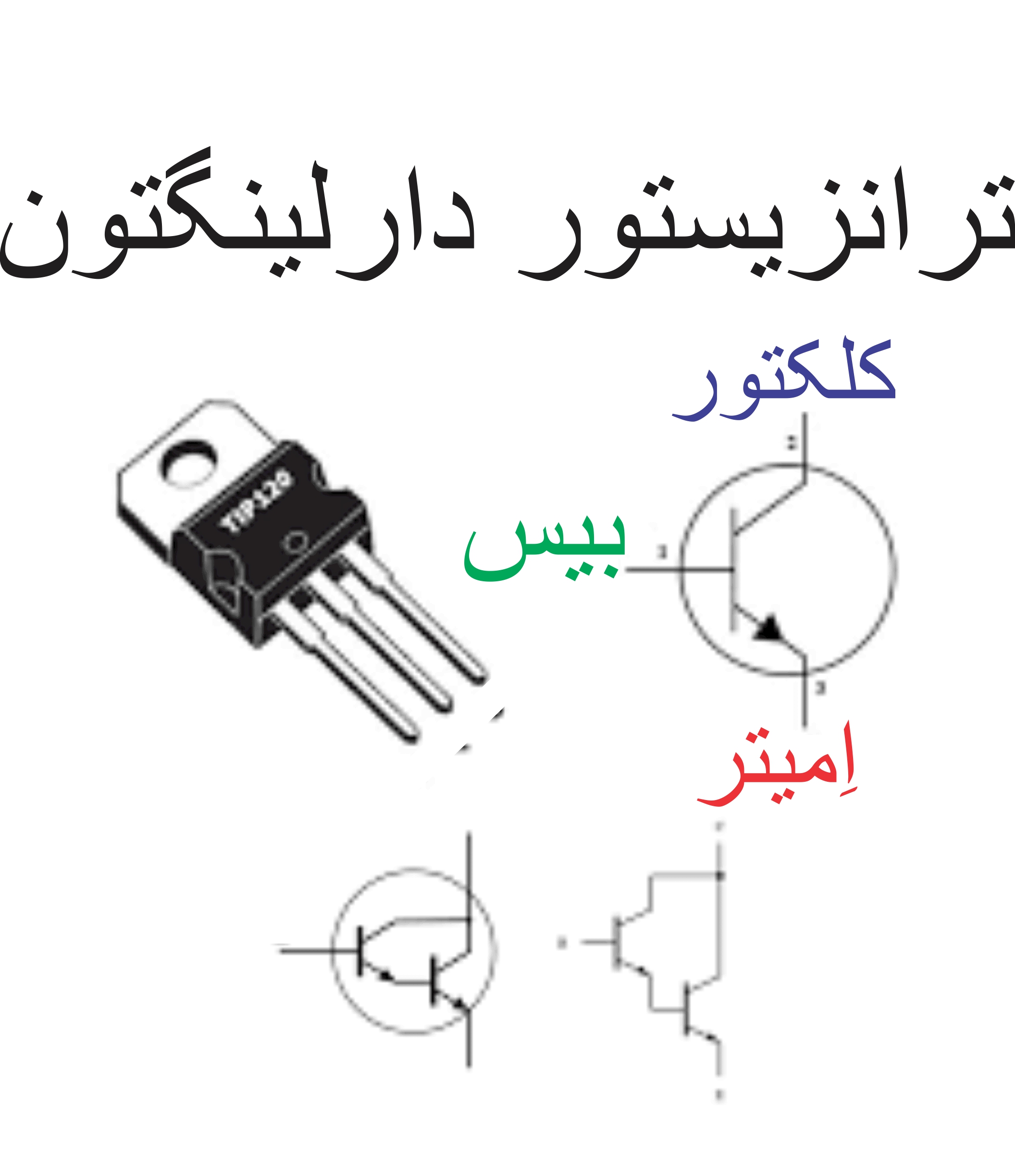
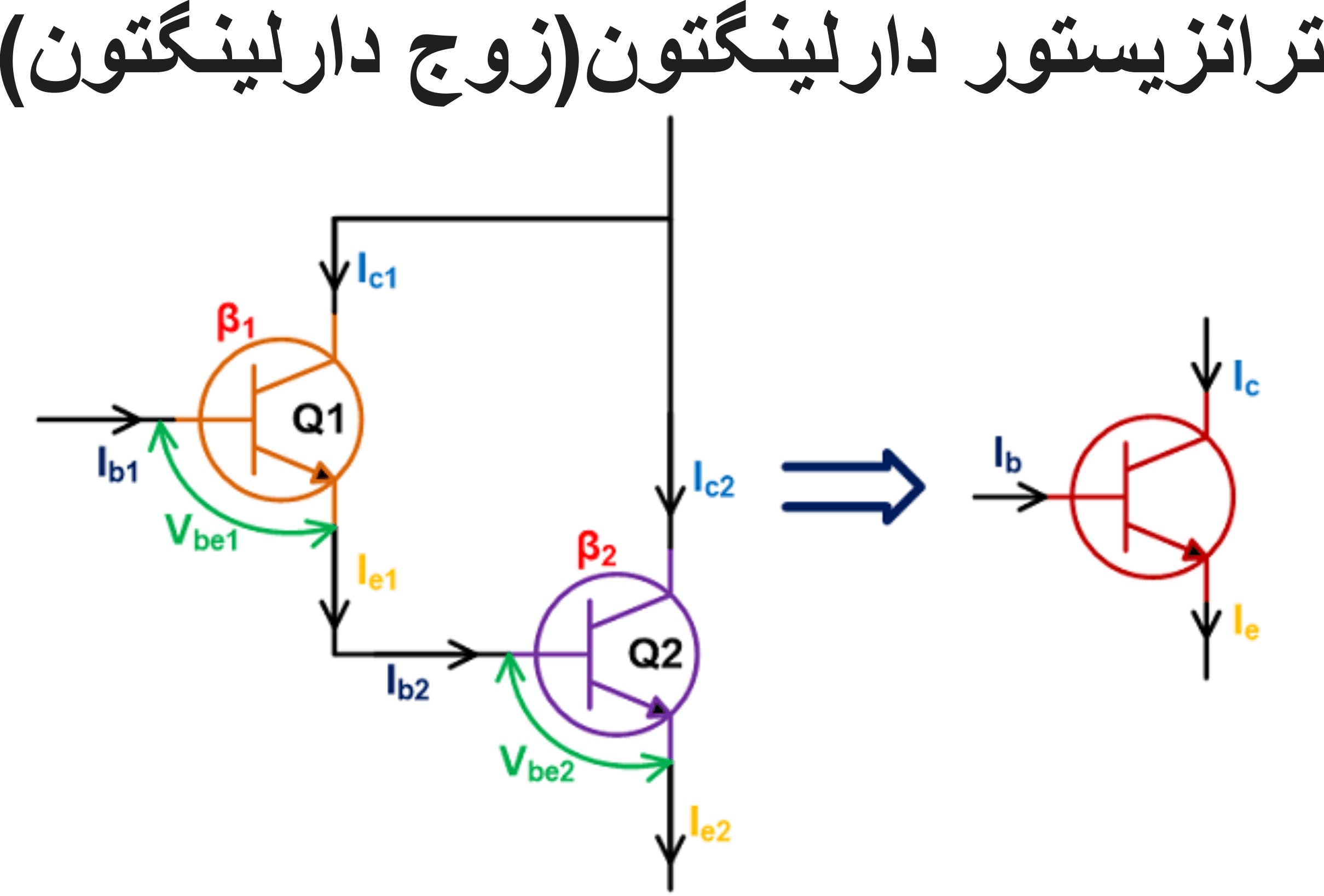
Section _ Understanding (Darlington transistor ) or Darlington pair
The Darlington transistor (Darlington pair) has free holes in the current amplifying junctions.
Researcher and author: Dr. ( Afshin Rashid)

_ife5.gif)
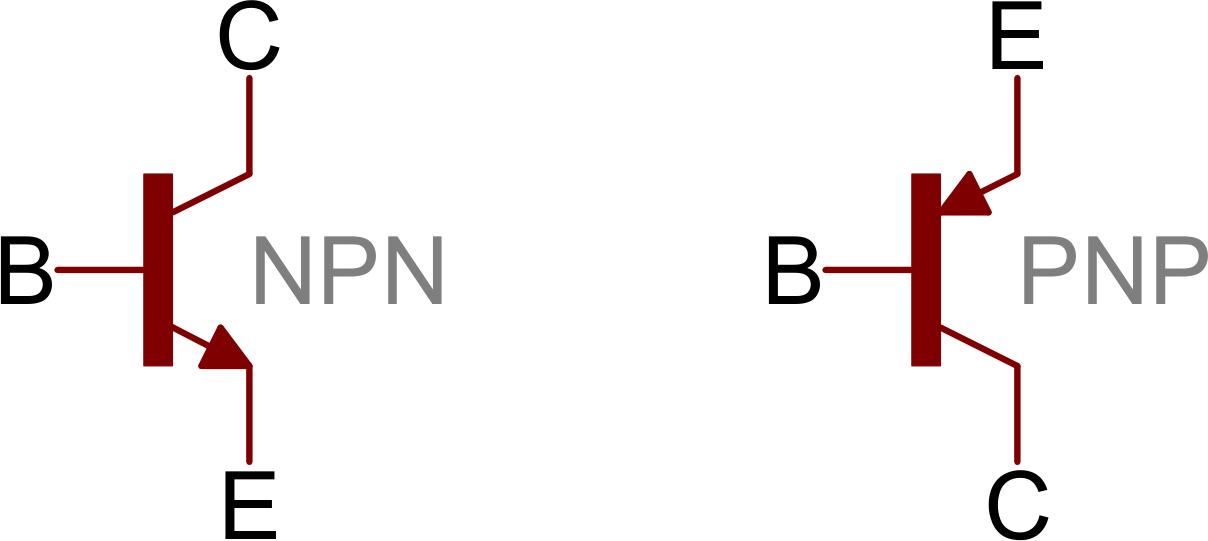
Note: Early transistors were made up of two semiconductor junctions and, depending on how these junctions were connected, they could be divided into two main types, PNP or NPN. To understand how a transistor works, we first need to understand how a semiconductor junction works. A PN junction is made by connecting two P and N semiconductors together.
N-type semiconductors have free electrons and P-type semiconductors have a large number of free holes. In simple terms, a free hole can be defined as a space in which there is a shortage of electrons. If we apply a voltage to this piece of semiconductor from outside, a current will flow in the circuit, and if we change the direction of the applied voltage, no current will flow through the circuit. This semiconductor junction models the simple operation of a diode. One of the applications of a diode is the rectification of alternating currents.
Since a capacitor is usually formed at the junction of an N-type semiconductor to a P-type semiconductor, the frequency response of a PN junction depends entirely on the quality of the construction and the size of the junction capacitor. For this reason, the first diodes made were not capable of operating at radio frequencies - for example, for detection. Usually, to reduce this unwanted capacitance, the junction area is reduced and brought to a point. Applying a voltage of the same polarity causes current to flow through a PN junction, and if the voltage polarity changes, no current will flow through the circuit. If we want to look at the matter simply, the function of a transistor can be considered as amplifying current. Consider a small logic circuit that under certain conditions produces a very small current at its output. You can amplify this current with a transistor and then use this strong current to turn an electric relay on and off. There are many other cases where you use a transistor to amplify voltage. Obviously, this feature is directly inherited from the current amplification feature of this device. It is enough to pass the input and amplified output current across a resistor to convert the low input voltage into the amplified output voltage.
There must be a minimum input current that a transistor can amplify. If this current is less than the minimum, the transistor will not show any current at its output. But as soon as you increase the input current of a transistor to more than the minimum, you will see amplified current at the output. This property of transistors is usually used to make electronic switches.
Researcher and author: Dr. ( Afshin Rashid)
Specialized PhD in Nano-Microelectronics