

Nano assemblers in the creation of new electronic nanodevices
(Nanoassemblers) in the electronic structure of flexible multidimensional materials or so-called (sTMD) depends on the crystal phase
Researcher and Author: Dr. ( Afshin Rashid)
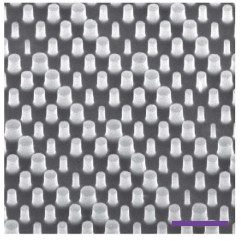
Note: In general, the electronic structure of flexible multidimensional sTMD materials is dependent on the crystal phase, resulting in a wide range of electronic characters including metallic, semi-metallic, semiconductor, and superconductor (SC) for different flexible multidimensional sTMD materials .
In particular, single-layer TMDs of the multidimensional nano-group are direct-gap semiconductors, while their bilayers and thicker multilayers have indirect gaps. For example, flexible multidimensional sTMD materials at the nanoscale all undergo a transition from indirect to direct gaps when passing from two layers to a single layer. The properties of flexible multidimensional sTMD materials at the nanoscale Modern semiconductors have revolutionized a wide range of technologies such as electronics, lighting, solar energy, and communications. Most nano-metals and metal nano-alloys, semiconductors, ceramics, and some nano-polymers that have a crystalline structure have long-range order in their structure. The extent of this order among atoms or ions is greater than 100 nm. The atoms or ions are regularly repeated in three dimensions. Materials with long-range order are called crystalline materials. If a material has a single large crystal, they are called single-crystal materials. Single-crystal materials are suitable for a wide range of electronic and optical applications, for example, computer chips are made of single-crystal silicon. Polycrystalline materials are composed of very small crystals arranged in three dimensions. Monolayers are classified according to their stability into H or T structures, where H is the most common structure with TMD symmetry and trigonal prismatic metal coordination, and T represents a structure with multidimensional symmetry and octahedral metal coordination, and are unstable structures.

In smart nanostructures, the concept of nano-assemblies is summarized in all the information and codes necessary to produce an identical entity. We have a very small machine that knows how to produce its own counterpart , which in nanoscience is referred to as a "nano-assembler". Nano-assemblers are composed of nanoparticles, and the first effect of reducing the size of the particles is to increase the surface area. Increasing the surface area to volume ratio of nanoparticles causes the atoms located on the surface to have a much greater effect on the physical properties of the particles than the atoms within the particle volume. This feature greatly increases the reactivity of nanoparticles. The structure of nano-assemblers is one of the properties of nanoparticles, the high surface area to volume ratio of these materials. Using this property, powerful catalysts can be produced in nanometer sizes. These nano-catalysts will greatly increase the efficiency of chemical reactions and will also significantly prevent the production of waste materials in the reactions. The use of nanoparticles in the production of other materials can increase their strength or reduce their weight. Increase their chemical and thermal resistance and change their reaction to light and other radiation. Using nanoparticles will greatly increase the strength-to-weight ratio of composite materials.

Conclusion:
In general, the electronic structure of flexible multidimensional sTMD materials is dependent on the crystal phase, resulting in a wide range of electronic characters including metallic, semi-metallic, semiconductor, and superconductor (SC) for different flexible multidimensional sTMD materials.
Researcher and Author: Dr. ( Afshin Rashid)
Specialized PhD in Nano-Microelectronics